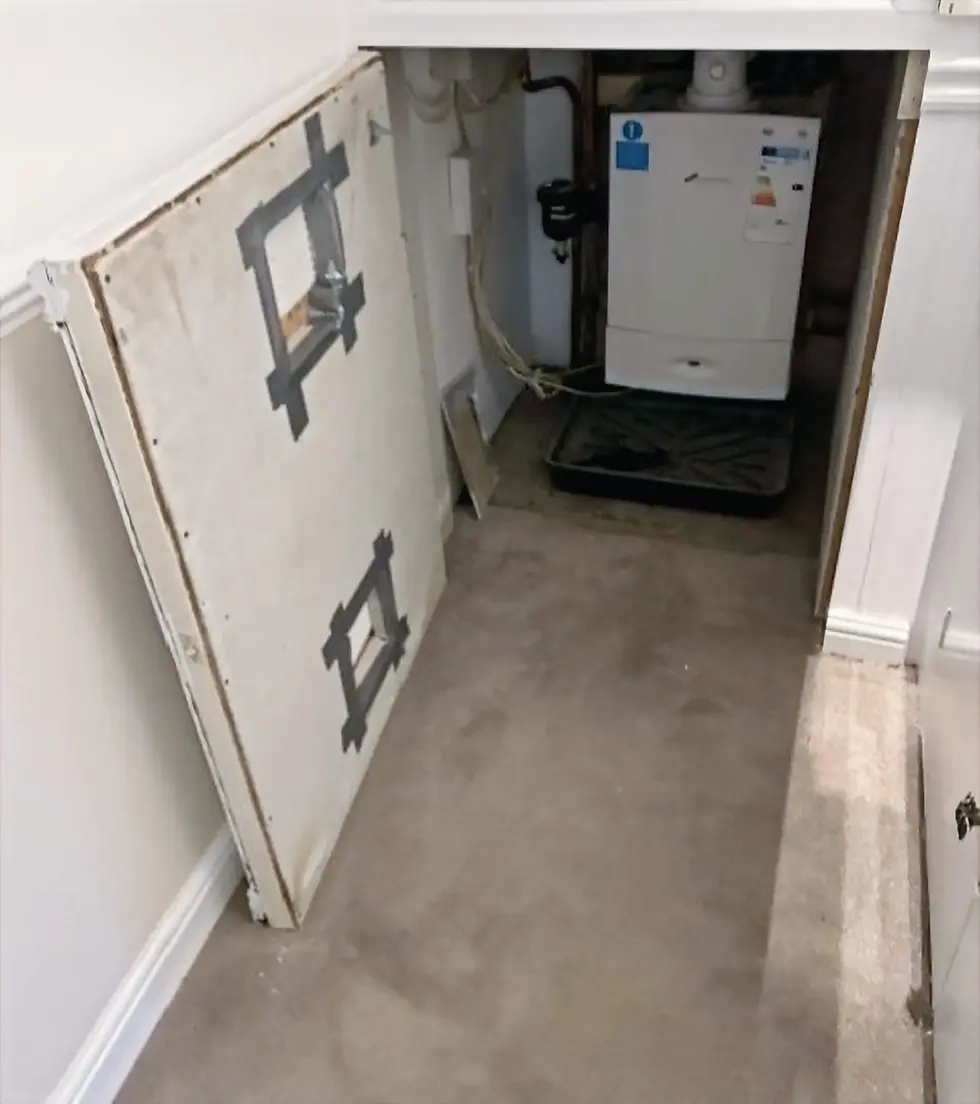
Asbestos Insulation board
removal
Asbestos Insulation Board, commonly called AIB, is a lightweight construction board that was widely used in UK buildings for fire protection, insulation, and partitioning. It contains asbestos fibres mixed with other materials such as cement or calcium silicate. Unlike asbestos cement, AIB is softer and more friable, meaning it can release dangerous asbestos fibres more easily if damaged, drilled, cut, or disturbed.
what is asbestos insulation board (AIB)?
Facts:
Asbestos Type: Amosite (most common)
Chrysotile
Crocidolite (Occassionally)
Colour: White, Brown, Blue
Commonly Found: Ceiling Tiles, Partition Walls, Fireproof Doors, Soffits, Lift Shaft Linings, Service Risers, Boiler Cupboards, Pipe Boxing, Suspended Ceilings, Window Panels, Electrical Cupboard Linings
Popular In: Schools, Hospitals, Offices, Council Housing, Industrial Buildings, Homes (pre-2000)
Good to know: AIB is considered a high-risk asbestos containing material because the fibres can become airborne relatively easily during damage or renovation work
Risk: High

was heavily used throughout the UK construction industry throughout the 1940s - 1980s. It was banned in the UK in 1985 however, some AIB products containing white asbestos continued to be used until it was banned completely in the UK in 1999.
It was often used in fire doors in schools, tower blocks, and commercial buildings with panels hidden inside the door leaf.
Asbestos Insulation Board
CAN YOU IDENTIFY IT BY SIGHT?
AIB can sometimes resemble plasterboard, but it typically has a denser core, appears grey or off-white, may have a dimpled or smooth finish, often sounds more solid when tapped, and usually has square edged boards. You cannot confirm asbestos alone. UKAS accredited analysis is required.
- AIB contains a much higher percentage of asbestos and is significantly more dangerous when disturbed.
- Even minor DIY work can release hazardous fibres
- Undamaged and sealed AIB may sometimes be managed safely in place under professional advice.
types of asbestos found in aib
Decorative Textured Coatings is the most commonly used asbestos type found in AIB. Amosite is part of the Amphibole asbestos family. It contains straight, needle like fibres that can lodge deeply in the lungs and usually contains approximately 20 - 25% asbestos in Asbestos Insulation Board.
Amosite (Brown Asbestos)
is also found in some AIB products, either on its own or mixed with amosite. It has curly, flexible fibres and was commonly used in mixed asbestos insulation boards, ceiling and wall panels, and general building products.
Chrysotile (White Asbestos)
Crocidolite (Blue Asbestos)
is less common in AIB but may occasionally be present in certain specialist insulation or fire protection products. It is considered the most hazardous form of asbestos as it has extremely fine fibres that are easily inhaled.
What You Should Know
Do not drill, cut, sand, or break the material. Keep people away from the area. Avoid sweeping or vacuuming dust. Arrange an asbestos survey or sample test. If AIB is in good condition and unlikely to be disturbed, professional management and encapsulation can sometimes be safer than removal.
AIB removal, in most cases, is classified as licensed asbestos work due to the higher risk of fibre release. Certain short duration or lower risk tasks may fall under non-licensed work or notifiable non-licensed work but always check with a professional first, nevertheless these tasks still require trained operatives using controlled working methods.

our projects
more projects
coming soon